
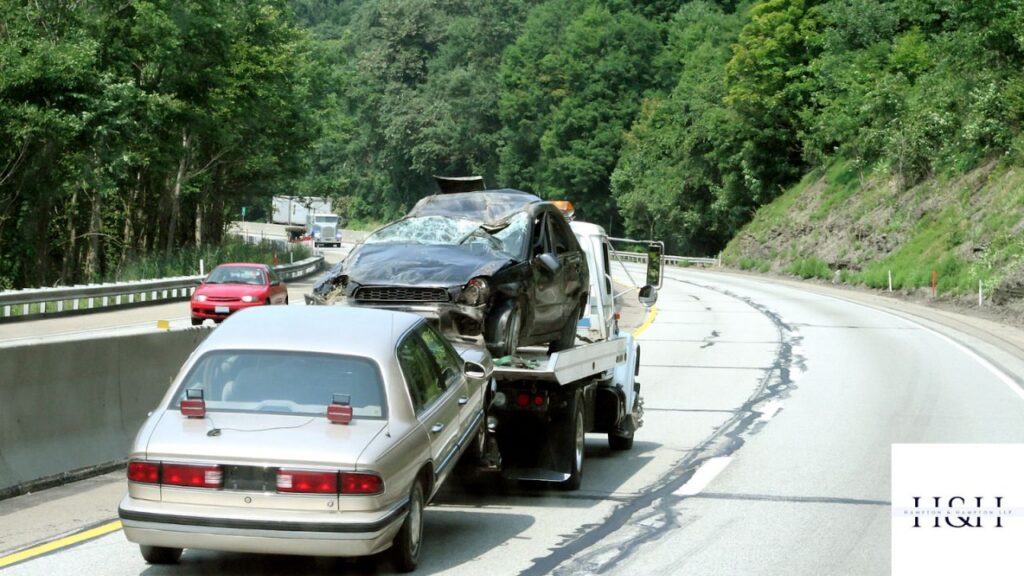
A car accident in Chicago can leave you owing thousands on a vehicle you can no longer drive. When the at-fault driver carries only minimum liability coverage, and your vehicle is totaled, that payout often falls short of your outstanding car loan. Illinois requires $25,000 per person in bodily injury liability and $20,000 in property damage liability as minimum coverage. The insurer pays actual cash value, not what you owe. The difference becomes your responsibility unless other coverage applies. If you were also injured in the accident, the same coverage limits may leave your personal injury claim undercompensated as well.
What to do: If you have gap insurance, file a claim with your own insurer after receiving the total loss payout. If you do not have gap insurance, check your policy for loan/lease payoff coverage or file through your collision coverage. For injury shortfalls, underinsured motorist coverage may apply after you exhaust the at-fault driver’s limits. Notify your own insurer before settling with the at-fault driver to preserve your rights.
Understanding how to address this gap requires distinguishing between two distinct issues: the shortfall in property damage and the shortfall in injury compensation. Each follows different coverage rules and requires different steps.
Illinois Minimum Coverage and Your Totaled Vehicle
Illinois law requires minimum liability limits of $25,000 per person and $50,000 per accident for bodily injury, plus $20,000 per accident for property damage. The Illinois Department of Insurance defines these coverage types on its consumer auto insurance page.
That $20,000 property damage limit is important when your vehicle is totaled. A driver carrying only minimum coverage can pay no more than $20,000 toward your vehicle, regardless of its value or the amount you owe on your loan.
If your car’s actual cash value is $22,000 and you owe $28,000 on the loan, the at-fault driver’s insurance might offer $20,000 at most. You could face an $8,000 shortfall: $2,000 between their limit and your car’s value, plus $6,000 between your car’s value and your loan balance.
How Actual Cash Value Creates a Loan Gap
Total loss claims are typically paid based on the market value of the damaged vehicle at the time of the loss. The Illinois Insurance Association explains that a new car’s value drops significantly as soon as you drive it off the lot, and depreciation continues for several years. The claim settlement is not connected to the outstanding loan.
Insurance companies determine actual cash value by assessing your vehicle’s condition, mileage, comparable sales in your area, and depreciation. Vehicles often depreciate faster than loan balances decrease, particularly in the first two to three years of ownership and especially with longer loan terms.
The result: many owners owe more than their car is worth at any given point during the loan. After an accident, they discover their insurance payout leaves them still owing money to a lender for a car they can no longer drive.
Gap Insurance: Coverage and Limitations
Gap insurance is optional coverage that pays the difference between what a car insurance company pays and what you still owe on your car loan or lease. The Illinois Department of Insurance defines it as coverage that pays the difference between what you owe on your auto loan and the actual cash value of your totaled car.
If you purchased gap insurance when you financed your vehicle, this coverage may apply when your car is declared a total loss. The gap policy pays the remaining loan balance after your collision or comprehensive coverage pays the actual cash value.
Gap insurance typically does not cover missed loan payments, late fees, penalties, extended warranties, or add-ons. It addresses only the loan-to-value shortfall. To use gap coverage, you generally must already have collision or comprehensive coverage on your policy. Gap insurance supplements these coverages; it does not replace them.
Options If You Lack Gap Insurance
Many vehicle owners discover after an accident that they either declined gap coverage or did not know it was available. Without it, several alternatives may apply.
- Loan/Lease Payoff Coverage: Some insurers offer a similar product under different names. This coverage works like gap insurance but typically limits the payout to a percentage of your vehicle’s value, often 25%. Check your declarations page or contact your insurer to confirm what coverage you carry.
- Collision Coverage: If you carry collision coverage with limits exceeding the at-fault driver’s property damage coverage, you may be able to file a claim through your own insurer. You will owe your deductible, but your insurer can pursue the at-fault driver’s insurance for the amount up to its limits. This approach often moves faster than waiting for the other driver’s carrier to pay.
- Personal Responsibility: If no applicable coverage exists, the remaining loan balance may become your financial obligation. Some lenders will negotiate payment terms or allow refinancing into a new vehicle loan. Others may pursue collection. This outcome underscores why gap coverage may be worth considering for anyone financing a vehicle with a small down payment or a loan term exceeding 48 months.
Underinsured Motorist Coverage and Bodily Injury Claims
The gap problem also affects injury claims, though the coverage that applies is different. According to the Illinois State Bar Association’s guide to automobile insurance, Illinois law requires automobile liability policies to provide a minimum level of uninsured and underinsured motorist bodily injury coverage.
Underinsured motorist coverage pays the difference between your coverage limits and the liability limits of the at-fault driver if those limits are lower than yours. If you are involved in an accident with an at-fault driver who has an insurance policy but it is insufficient to compensate you for the injuries you sustained, underinsured motorist coverage may address that shortfall.
For example, if a claim is worth $50,000 but the at-fault driver has liability insurance for only $25,000, your insurance company may pay the difference of $25,000, provided your own underinsured motorist limits are $50,000 or more. If your limits are only $25,000, you may collect nothing additional in this situation.
The Exhaustion Requirement Under Illinois Law
Under 215 ILCS 5/143a-2, a policy providing underinsured motor vehicle coverage may include a clause denying payment until the limits of liability under all bodily injury liability insurance policies applicable to the underinsured motor vehicle have been partially or fully exhausted by payment of judgment or settlement. This statute is codified in the Illinois Insurance Code.
This may create a specific sequence:
- Pursue the at-fault driver’s liability coverage to its limits.
- Document the settlement amount and confirm that the at-fault driver’s coverage is exhausted.
- Notify your own insurer and file the underinsured motorist claim.
- Proceed through your policy’s claims process, which may require arbitration.
Protecting Your Rights Before Settling
If you plan to pursue an underinsured motorist claim after settling with the at-fault driver, you should notify your own insurer before finalizing that settlement.
Under Illinois law, an insurer cannot exercise any right of subrogation under a policy providing additional uninsured motorist coverage against an underinsured motorist where the insurer has been provided with written notice in advance of a settlement and fails to advance a payment equal to the tentative settlement within 30 days.
Your insurer has the right to know about the settlement because it may have subrogation rights it wants to preserve. Provide written notice describing the proposed settlement amount and give your insurer time to respond before signing a release with the at-fault driver’s carrier.
Common Mistakes After a Coverage Shortfall
Accident victims frequently undermine their own claims by taking certain actions before understanding the consequences.
- Settling without notifying your insurer. If you sign a release with the at-fault driver’s carrier before giving your own insurer written notice, you may jeopardize your underinsured motorist claim. Your insurer’s subrogation rights are protected under Illinois law, and failing to notify them may affect your coverage for that accident.
- Assuming you lack underinsured motorist coverage. Illinois mandates uninsured motorist bodily injury coverage of at least $25,000 per person and $50,000 per accident. Your policy must provide underinsured motorist coverage if your uninsured motorist coverage limits exceed those minimums. Many Illinois drivers have this coverage without realizing it. Review your declarations page before concluding you have no recourse.
- Missing the arbitration deadline. Most Illinois auto policies require you to demand underinsured motorist arbitration within two years of the accident. The Illinois State Bar Association notes that this contractual two-year limitation may override any longer statutory period. Check your policy language and act well before any deadline approaches.
- Relying on the at-fault driver’s word. The at-fault driver may claim they have full coverage or sufficient limits. Request the policy limits in writing from their insurer. Only the insurance company can confirm the actual available coverage.
When Legal Counsel May Help
Underinsured motorist claims create an unusual situation: you are filing a claim against your own insurance company. Your insurer has received your premiums for years and may have handled other claims on your behalf.
When you file this type of claim, that same company has a financial interest in paying as little as possible. The relationship can shift from cooperative to adversarial.
This conflict is why many accident victims with underinsured motorist claims consult with an attorney before negotiating. An attorney can review your policy limits, advise on the exhaustion requirement, handle communications with both insurers, and if necessary, pursue arbitration.
If you have questions about your claim, speak with our Chicago car accident attorneys about your options.
Steps After a Total Loss with a Coverage Gap
If your vehicle is totaled and you suspect the at-fault driver’s coverage will not satisfy your loan or your injuries, consider these steps:
Gather your loan balance statement from your lender and compare it to your vehicle’s estimated actual cash value. Review your own auto policy for collision coverage limits, gap coverage or loan/lease payoff coverage, and underinsured motorist limits. Request the at-fault driver’s policy limits in writing from their insurer.
Document all medical treatment and keep records of all accident-related expenses. Notify your own insurer before accepting any settlement from the at-fault driver’s carrier. The Illinois Department of Insurance Consumer Assistance at 866-445-5364 can answer general questions about insurance coverage and help you understand your rights as a policyholder.
Coverage Types After a Total Loss
| Coverage Type | What It May Pay | When It May Apply | Who Provides It |
|---|---|---|---|
| At-fault driver’s property damage liability | Actual cash value up to their policy limit | When another driver causes the accident | Other driver’s insurer |
| Your collision coverage | Actual cash value minus your deductible | Regardless of fault | Your insurer |
| Gap insurance | Remaining loan balance after ACV payment | Total loss only | Your insurer or dealer |
| Loan/lease payoff coverage | Up to 25% of ACV beyond the loan balance | Total loss only | Your insurer |
| Underinsured motorist coverage | Bodily injury damages beyond at-fault limits | After exhausting at-fault coverage | Your insurer |
FAQ
Q1. Does gap insurance pay if the accident was not my fault?
Gap insurance typically applies when your vehicle is declared a total loss, regardless of fault. The coverage pays the shortfall between your car’s actual cash value and your loan balance, whether you caused the accident or someone else did.
Q2. Can I sue the at-fault driver for the loan balance my insurance does not cover?
You may be able to pursue the at-fault driver personally for damages their insurance did not cover. The challenge is collectability. If the driver carried only minimum coverage, they may lack assets to satisfy a judgment.
Q3. What if I did not know I had underinsured motorist coverage?
Illinois mandates uninsured motorist coverage of at least $25,000 per person and $50,000 per accident. Your automobile insurance policy must provide underinsured motorist coverage if your uninsured motorist coverage limits exceed those minimums. Review your declarations page or call your insurer to confirm your limits.
Q4. How long do I have to file an underinsured motorist claim in Illinois?
Most Illinois auto policies require you to demand arbitration within two years of the accident. This contractual limitation may override any longer statutory period. Check your policy language and file well before the deadline.
Q5. Will filing an underinsured motorist claim raise my insurance rates?
Underinsured motorist claims are filed against your own policy, but they arise from accidents caused by someone else. Whether your rates increase depends on your insurer’s practices. Some insurers do not surcharge for these claims because you were not at fault.